Wednesday, October 6, 2021

Bladder Cancer Types, Stages, and Grades

Stages of Bladder Cancer

Grades of Bladder Cancer


Names of Bladder Cancer

3 Types of Bladder Cancer

Pathology, Pathologists, and Pathology Report


For a quick glossary of terms concerning bladder cancer and pathology, types, stages, and grades click here.

After your TURBT (Transurethral Resection of Bladder Tumor - the surgery to take out the tumor, read about it more here ), they will take your tumor and send it to pathology, or a lab, in which they will look very closely at the sample of your tumor, under a microscope, looking at the cellular level of the tumor cells and bladder cells surrounding the tumor. The physicians specifically trained to do this are called pathologists

Please remember, that not only can you get a second opinion from a urologist or oncologist, you can also get a second opinion on your pathology. EVERYTHING concerning your treatment is about the pathology, so its vital that you understand what it is, and you are sure that the pathology is correct. 

After the tumor or tissue sample has been identified and assessed, they will give your doctor a pathology report, that gives all the information about the tumor. This report will tell you if the tumor is cancer or not. If it is cancer then the report will tell you the type of cancer, the stage of cancer, and the grade. 

Be sure to get a copy of your pathology report. Your physician will sit down with you and discuss the pathology report. You are not going to understand a lot of what is said, so it's important to have that report so you can later look up information on your own.

If the cancer is too large, or has spread too far, they might not be able to get all of it, and have to use chemotherapy and radiation to shrink the tumors. Sometimes they have to do multiple surgeries and biopsies to get all the tumors. 

If the tumor has invaded the muscle wall (stage 2 and above) then you will most likely need to have your bladder removed. If you want some basic understanding and definitions of possible surgeries and treatments with bladder cancer, click here.

The pathologist will determine if there are clean margins in the tissue samples. This means that when a tumor is taken out, at the outer edge of where the tumor was, healthy tissue is removed also. They check to make sure there is a large chunk of healthy tissue taken out that was under the tumor, meaning that "they got it all," and all the cancer cells have been removed. If you have clean margins that will mean that that got out all of the cancer tissue. 

If they didn't get clean margins, they will need to take you back into surgery to remove more of the tumor, and verify once again that they got clean margins.  

If it's a benign tumor, that means that it's not cancerous. It only grows in one place and won't spread or invade other parts of your body. Benign tumors may grow large but do not spread into, or invade, nearby tissues or other parts of the body.

If the tumor is malignant, then it means that it is cancerous. It means that the tumor is an abnormal mass of tissue when cells grow and divide more than they should, or do not die when they should, and if not taken out, it will spread and invade all over your body. Malignant tumors can spread into, or invade, nearby tissues. They can also spread to other parts of the body through the blood and lymph systems. These tumors are also called neoplasms.

If it's cancer, they will tell you the type, the stage, and the grade of the tumor. I will explain what all of this means later in this article. Just stick with me. It will all make sense. 

Most of us need to read, and re-read all of this information. It's a lot to process. Bookmark this page, and you can always come back to it when you need. You have got this. 💗

I would recommend bringing a loved one with you when you get the results of your pathology report. You might see written on a paper in black and white that you have cancer. No more time for denial. It might be right there in front of you. Believe me, it's quite the shock. Personally, when I heard the word cancer come out of my doctors mouth, I was not able to process anything else. It was almost like what you see in the movies. All the voices in the room become white noise, and I wasn't hearing what anyone was saying or processing it.

This is part of the first stage of grief - shock. Click here for an article about going through the 7 stages of grief when you are diagnosed with cancer. It's normal, it's expected, and it's important to give yourself plenty of time, space, and grace as you go through this experience. Lots of intense emotions are going to be flying around as you go through the different stages of grief. There is a lot of loss with bladder cancer.

Be sure the loved one knows what you need from them before you get to the doctors office. Tell them if you get bad news, it's going to be their job to ask questions (write them down before hand), and write the answers down. 


Bladder Cancer Tumor Names

Three types of bladder cancer may form, and each type of tumor can be present in one or more areas of the bladder, and more than one type can be present at the same time:

  • Papillary tumors stick out from the bladder lining on a stalk. It grows into the hollow center of the bladder, away from the bladder wall, instead of deeper layers of the bladder wall. It looks like cauliflower, coral or a fern.
  • Sessile tumors lie flat against the bladder lining. Sessile tumors are much more likely than papillary tumors to grow deeper into the layers of the bladder wall.
  • Carcinoma in situ (CIS) is a cancerous patch of bladder lining, often referred to as a “flat tumor.” The patch may look almost normal or may look red and inflamed. Most of the time it looks reddish, flat, and velvety looking patches, and does not grow into the hollow part of the bladder. CIS is a type of nonmuscle-invasive bladder cancer that is of higher grade and increases the risk of recurrence and progression. At diagnosis, approximately 10% of patients with bladder cancer present with CIS. 

Bladder Cancer Types

The type of bladder cancer depends on how the tumor’s cells look under the microscope. The 3 main types of bladder cancer are:

  • Urothelial carcinoma. Urothelial carcinoma (or UCC) accounts for about 90% of all bladder cancers. It also accounts for 10% to 15% of kidney cancers diagnosed in adults. It begins in the urothelial cells found in the urinary tract. Urothelial carcinoma is sometimes also called transitional cell carcinoma or TCC.Urothelial carcinoma (transitional cellcarcinoma) is the most common type of bladder cancer. Urothelial carcinoma starts in the urothelial cells. Urothelial cells are cells that line the inside of the bladder. Urothelial cells also line other parts of the urinary tract, such as the kidney, the ureters, and the urethra. People with bladder cancer may also
    have tumors in these places. It is important that these other areas are also checked for tumors. This is often checked with a yearly or once every two years CT Scan. Click here for more information about that.

  • Squamous cell carcinoma. Squamous cells develop in the bladder lining in response to irritation and inflammation. Over time, these cells may become cancerous. Squamous cell carcinoma accounts for about 4-5% of all bladder cancers. Squamous cell carcinomas have a higher chance of becoming invasive.

  • Adenocarcinoma. This type accounts for about 1-2% of all bladder cancers and develops from glandular cells. Adenocarcinomas of the bladder have a higher likelihood of being invasive at diagnosis. 

There are other, less common types of bladder cancer, including sarcoma of the bladder and small cell bladder cancer, among others. Sarcomas of the bladder often begin in the fat or muscle layers of the bladder. Small cell bladder cancer is a rare type of bladder cancer that is likely to spread to other parts of the body.

What is Upper Tract Urothelial Carcinoma (UTUC)? 

While the majority of bladder cancers (approximately 90-95%) arise in the bladder, the urothelial cells that line the bladder are found in other locations in the urinary system. Sometimes these urothelial cancers can occur in the lining of the kidney or in the ureter that connects the kidney to the bladder. This is known as upper tract urothelial cancer (UTUC) correspond to a subset of urothelial cancers that arise in the urothelial cells in the lining of the kidney (called the renal pelvis) or the ureter (the long, thin tube that connects that kidney to the bladder).

Grade 1              Grade 2            Grade 3

What are the Grades of Bladder Cancer Tumor

Grade is expressed as a number between 1 (low) and 3 (high, i.e. G3); the higher the number the less the tumor resembles a normal cell. In lieu of numbers to grade a bladder cancer tumor, your doctor may refer to the tumor simply as low or high grade.

 Stages of Bladder Cancer

Above is the picture of the layers of the bladder wall. This is super important to know, in understanding staging of bladder cancer, because it's all about what layers the tumor has grown into.  

Stage suggests the location of the tumor in relation to the inner lining of the bladder. The higher the stage the further the tumor has grown away from its original site on the surface. The following are the stages for bladder tumors:

 
  • T0: No tumor
  • Ta: Papillary tumor without invading the bladder wall
  • TIS (CIS): Carcinoma in situ (non-invasive flat high-grade (G3) cancer)
  • T1: Tumor invades the connective tissue under the surface lining
  • T2: Tumor invades the muscle layer
  • T3: Tumor penetrates the bladder wall and invades the surrounding fat layer
  • T4: Tumor invades other organs (i.e., prostate, uterus, vagina, pelvic wall)
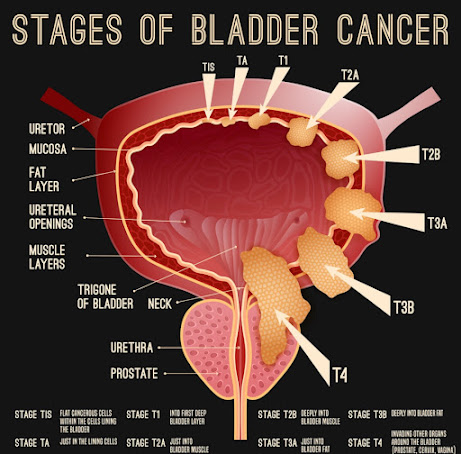
Stages of Bladder Cancer

One of the things you will learn from the pathology report is what stage the bladder cancer is. 

A more simple way to understand staging is to think how large the tumor is, and how far it's grown into the bladder, or outside the bladder, and if it has spread to other parts of the body or lymph nodes.

After someone is diagnosed with bladder cancer, doctors will find out if it has spread, and if so, how far. This process is called staging. The stage of bladder cancer describes the extent or amount of cancer is in the bladder (or in the case of stage 4 how far it has grown out of the bladder). Staging is one of the most important factors in deciding how to treat bladder cancer and determining how successful treatment might be.  It helps determine how serious the cancer is and how best to treat it. 

To find the cancer’s stage, doctors try to answer these questions:

  • How far has the cancer grown into the wall of the bladder?
  • Has the cancer reached nearby tissues or organs?
  • Has the cancer spread to the nearby lymph nodes or to distant organs?

The stage of bladder cancer is based on the results of physical exams, biopsies, and imaging tests (CT, ultrasound, MRI, PET scan, x-rays, etc.), as well as the results of surgery or TURBT, in which the tumor and tissue samples are removed and sent to pathology for analysis. Click here if you want to review what a TURBT is.

Staging System

A staging system is a standard way for the cancer care team to describe how far a cancer has spread. The staging system most often used for bladder cancer is the American Joint Committee on Cancer (AJCC) TNM system, which is based on 3 key pieces of information:

  • T describes how far the main (primary) tumor has grown through the bladder wall and whether it has grown into nearby tissues.
  • N indicates any cancer spread to lymph nodes near the bladder. Lymph nodes are bean-sized collections of immune system cells, to which cancers often spread first.
  • M indicates if the cancer has spread (metastasized) to distant sites, such as other organs, like the lungs or liver, or lymph nodes that are not near the bladder.

As a rule, the lower the number, the less the cancer has spread. A higher number, such as stage IV, means a more advanced cancer. Within a stage, an earlier letter (like a vs. b) means a lower stage. Cancers with similar stages tend to have a similar outlook and are often treated in much the same way.

Bladder cancer staging can be complex. If you have any questions about your stage, please ask your doctor to explain it to you in a way you understand. 

Has the Tumor Invaded the Muscle Layer?

The most important differentiation in the treatment of bladder cancer is if it has invaded the muscle or not. The treatments are radically different, and as you read information about bladder cancer, and discuss this with others in bladder cancer groups and talk about it with your doctor they will use the term "invasive" and "non-muscle invasive" and "muscle invasive".

Please review the anatomy of the bladder layers above. Remember, in general terms the bladder is a really large muscle that stores urine for convenience, and also pushes out the urine when it's time to urinate or void. 

The stages of bladder cancer is all based on which layer of the bladder, the tumor has invaded or grown into. 

Noninvasive - stage 0 Noninvasive bladder cancer includes noninvasive papillary carcinoma (Ta) and carcinoma in situ (CIS). Noninvasive papillary carcinoma is a growth found on a small section of tissue that is easily removed. This is called stage Ta. CIS is cancer that is found only on or near the surface of the bladder, which is called stage Tis.

Non-muscle invasive bladder cancer - stage 0 and stage 1 (NMIBC - meaning it does NOT go into the muscle layer of the bladder) is the most common bladder cancer. I know it sounds weird using the word invasive. You have to focus on the "non-muscle" part of the term. This is the earliest stage of bladder cancer, and least invasive. It includes stage 0 and stage 1. About 90% of bladder cancers are non-muscle invasive, and are the most common type.  

Muscle-invasive bladder cancer -  stage 2, 3, and 4 is when the cancer has grown into deeper layers of the muscular bladder wall. These are more likely to spread to other organs and are harder to treat. This includes stages 2, 3, and 4. Often these stages will mean the removal of the bladder entirely (called a cystectomy, click here for some basic definitions and types of surgeries available). 

It is important to note that non-muscle-invasive bladder cancer has the possibility of spreading into the bladder muscle or to other parts of the body. Additionally, all cell types of bladder cancer can spread beyond the bladder to other areas of the body through a process known as metastasis.

Stage 0 Bladder Cancer

Stage 0 bladder cancer is tumor found only growing in the very first layer, or lining of the bladder wall, called the urothelium layer or transitional epithelium. It has not grown into the connective tissue or muscle of the bladder. It has not spread to nearby lymph nodes (N0) or metastasized or spread to distant sites in the body (M0).

Nearly all bladder cancers start in the lining or urothelium. As the cancer grows into or through the other layers in the bladder, it becomes more advanced (the stage goes up).

There are many names that people use to describe cancer, and it can be really confusing. I have gathered all of these names into one place, and described what all the letters and words mean. Click here  for that basic list with definitions. I will go into greater detail below, about what all of it means.

There are two main types of stage 0 bladder cancer: Ta and CIS

Ta Tumor

Ta / non-invasive papillary carcinoma / noninvasive / stage Ta / Ta0 / papillary transitional cell carcinoma / TCC  (see above picture)

  • One type of stage 0 bladder cancer
  • The "T" stands for tumor
  • The "a" means its in the very early stages of cancer
  • The "0" stands for stage zero
  • Non-invasive means it's not in the muscle, remember stage 0 means it's only in the very first layer, or lining of the bladder wall, called the urothelium layer or transitional epithelium.
  • Papillary is the description of what it looks like. It grows into the hollow center of the bladder and looks like cauliflower, coral or a fern. 
  • Transitional Cell Carcinoma is just meaning the location of where it is. This bladder cancer forms in the first layer of the bladder wall called the urothelium layer or transitional epithelium layer.  
  • Also called Non-muscle invasive bladder cancer (NMIBC) : it has not invaded the muscle wall of the bladder
  • Also called Superficial bladder cancer: it's only on the first layer of the bladder wall
  • Also called Non-invasive carcinoma: it has not invaded the muscle wall of the bladder
  • Also called Urothelial carcinoma / transitional cell carcinoma (TCC): transitional and urothelial cells are in your urinary system. They are part of the transitional epithelium layer or urothelium layer. This layer lines the bladder, ureters, urethra, and kidneys. This is why a yearly CT needs to be done when you have bladder cancer. It can spread to other areas of the urinary system.
CIS or Carcinoma in situ Tumor

CIS / Tis / CIS0 / Tis0 /stage Tis / stage 0is / carcinoma in situ (in SY-too) / non-invasive carcinoma / urothelial carcinoma in situ / flat carcinoma in situ  (see above picture)

  • One type of stage 0 bladder cancer 
  • The "T" stands for tumor
  • The "C" stands for carcinoma which is cancer that forms in the urothelium layer or transitional epithelium of the bladder. This is the first layer of the bladder wall.
  • The "is" stands for in situ (in SY-too), which means in its original place. So the cancer cells are only found in the layer they first formed and has not spread further, which for bladder cancer means the lining of the first layer of the bladder wall, called the urothelium layer or transitional epithelium.
  • Non-invasive means that it has not invaded the muscle layer of the bladder
  • Description of CIS: This type of cancer is reddish, flat, and velvety looking patches, and does not grow into the hollow part of the bladder. 
  • CIS is high grade: This is a high grade cancer (also called grade 3). I will talk more about grades later on. What this means is that although CIS is a stage 0 cancer, it is high grade, which makes it more aggressive, with a tendency toward progressing to higher bladder stages. It has increased chances of coming back again. It is harder to cut all of it out, because it's harder to see.
  • Also called Non-muscle invasive bladder cancer (NMIBC) : it has not invaded the muscle wall of the bladder
  • Also called Superficial bladder cancer: it's only on the first layer of the bladder wall
  • Also called Non-invasive carcinoma: it has not invaded the muscle wall of the bladder
  • Also called Urothelial carcinoma / transitional cell carcinoma (TCC): transitional and urothelial cells are in your urinary system. They are part of the transitional epithelium layer or urothelium layer. For some reason a CIS tumor is rarely called a transitional cell carcinoma. Usually that term is associated with a Ta tumor. This layer lines the bladder, ureters, urethra, and kidneys. This is why a yearly CT needs to be done when you have bladder cancer. It can spread to other areas of the urinary system. 

Stage 1 (T1, N0, M0) Bladder Cancer

Stage 1 bladder cancer has grown through the urothelium/transitional cell layer and grown into or invaded the lamina propria layer of the bladder wall. The lamina propria is also called the submucoa, and is a thin layer of connective tissue. This layer contains blood vessels, nerves and glands. 

Stage 1 bladder cancer has NOT reached the muscle layer of the bladder. It has not spread to nearby lymph nodes (N0) or metastasized or spread to distant sites in the body (M0).

Just like stage 0, stage 1 bladder cancer is also called non-muscle invasive bladder cancer (NMIBC),  meaning it has not invaded the muscle wall of the bladder. 


Stage 2 (T2; T2a; T2b, N0, M0) Bladder Cancer

The cancer has grown into the inner (T2a) or outer (T2b) muscle layer of the bladder wall, but it has not passed completely through the muscle to reach the layer of fatty tissue that surrounds the bladder.

The cancer has not spread to nearby lymph nodes (N0) or to distant sites (M0).

This is muscle invasive bladder cancer. Most of the time stage 2 or higher bladder cancer will mean eventual removal of the bladder. Click here for a list and definitions of bladder cancer treatments, surgeries, and therapies.


 Stage 3 Bladder Cancer

Stage 3A

  • T3a, T3b, or T4a, N0, M0:

    The cancer has grown through the muscle layer of the bladder and into the layer of fatty tissue that surrounds the bladder (T3a or T3b).

    It might have spread into the prostate, seminal vesicles, uterus, or vagina, but it's not growing into the pelvic or abdominal wall (T4a).

    The cancer has not spread to nearby lymph nodes (N0) or to distant sites (M0).

  •  T1-4a, N1, M0:

    The cancer has grown into the layer of connective tissue under the lining of the bladder wall (T1), OR into the muscle layer of the bladder wall (T2), OR into the layer of fatty tissue that surrounds the bladder, (T3a or T3b) OR it might have spread into the prostate, seminal vesicles, uterus, or vagina, but it's not growing into the pelvic or abdominal wall (T4a).

          AND the cancer has spread to 1 nearby lymph node in the true pelvis (N1).

          It has not spread to distant sites (M0).

Stage 3B

  • T1-T4a, N2 or N3, M0:

    The cancer has grown into the layer of connective tissue under the lining of the bladder wall (T1), OR into the muscle layer of the bladder wall (T2), ORinto the layer of fatty tissue that surrounds the bladder (T3a or T3b), OR it might have spread into the prostate, seminal vesicles, uterus, or vagina, but it's not growing into the pelvic or abdominal wall (T4a).

          AND the cancer has spread to 2 or more lymph nodes in the true pelvis (N2) or to lymph nodes               along the common iliac arteries (N3).

          It has not spread to distant sites (M0).

Stage 4 Bladder Cancer 

Stage 4A

  • T4b, any N, M0: 

    The cancer has grown through the bladder wall into the pelvic or abdominal wall (T4b). 

    It might or might not have spread to nearby lymph nodes (Any N).

    It has not spread to a distant sites (M0)

  • T4b, any T, any N, M1a: 

    The cancer might or might not have grown through the wall of the bladder into nearby organs (Any T).

    It might or might not have spread to nearby lymph nodes (Any N).

    It has spread to distant lymph nodes (M1a).

Stage 4B 

  • Any T, any N, M1b:

    The cancer might or might not have grown through the wall of the bladder into nearby organs (Any T).

    It might or might not have spread to nearby lymph nodes (Any N).

    It has spread to 1 or more distant organs, such as the bones, liver, or lungs (M1b).


I Can't Pee! BCG and Acute Urinary Retention


Acute Urinary Retention

Acute = severe and sudden onset

Urinary = system that deals with urine including bladder, urethra, ureter, and kidneys

Retention  = holds onto 

So acute urinary retention is an immediate problem of holding onto urine, or not being able to urinate. Your bladder does not completely empty. This means that someone cannot start the urination process or they are unable to completely empty their bladder. 

6 days ago I got BCG #12 (the 3rd dose of the 2nd maintenance). Each BCG treatment gets a little worse, and I was expecting that. 

What I wasn't expecting was not being able to pee! This is a potential side effect of BCG, that not many people have, or talk about. 


Can't Urinate After BCG? It's an Emergency!

Before I go on with my experience, I want to make it very clear....

If you get BCG, and at some point you can't pee - this is an emergency! Truly it can even be life-threatening.   

You need to get help immediately from your Urologist, and if they are not available then go to an urgent care or emergency room/department (ER or ED). 

Before going to an urgent care, make sure they can give you a foley catheter to go home with. If they don't have foley catheters (like mine) then you will need to go to the ER.

The reason urinary retention is considered an emergency is because it disrupts the natural flow of urine. If this goes untreated, the following can start to happen: 

  • Your bladder can be stretched too far or for too long, and it can cause serious damage to the bladder. If it gets really bad, it can permanently damage the bladder.
  • As urine backs up, it can damage the kidneys, and if it's still not fixed will lead to kidney failure. Good news though, if at some point your kidneys are stressed (you can see this on your lab work) once you are able to urinate again, your kidneys usually bounce right back to normal. 
  • The backup in your kidneys can cause higher blood pressure. Your body is overloaded with fluid, and so it will start pushing it elsewhere including your vasculature (your arteries and veins, thus the high blood pressure) lungs, and other spaces in the body. 
  • You might have slight chest pain or have difficulty breathing, again this is because of the extra fluid that is in your body. 

This was starting to happen to me. 

My abdomen was swollen beyond just my bladder. I had water gathering in my whole abdomen. 

My legs were starting to swell. 

I was having a harder time breathing because of the increased fluid everywhere, including in my lungs. 

When I walked into the ER, my blood pressure was 210/88 (regular is 120/80).

I'm so glad I got help when I did! 

Signs and Symptoms of Acute Urinary Retention

The symptoms you will have with acute urinary retention are the inability to urinate, urgent urination, pain and/or bloating in the lower abdomen. 

Often the pain becomes severe when it's an acute problem. You might have some flank pain (lower back on the sides), have swelling in your legs, or have some slight chest pain, or starting to have difficulty breathing (it feels like your chest is heavy and you can't get enough air).

Causes of Acute Urinary Retention

If you have acute urinary retention after BCG... the cause is the BCG! But it can be a little more complicated than that. When you get BCG there are some side effects that are common. I talk in depth about what BCG is, and many of the side effects here.

First, BCG irritates the bladder and urethra, creating a lot of inflammation and swelling. This is called cystitis and urethritis. 

cystis = bladder

urethr = urethra

itis = inflammation

Trauma or severe irritation to the bladder and urethra are both potential things that could cause you not to urinate. The bladder is a muscle, and if it becomes too inflamed, then it can't squeeze in order to push urine out. 

If your urethra gets inflamed, being a tube to let urine out, the tube might clamp off, and not allow urine to pass. Then the urine would back up in the bladder, and then the kidneys.

Secondly, BCG can also cause bleeding, which I did have as well. This bleeding can lead to blood clots. Blood clots can plug up the urethra and not allow urine to pass. 

Blood is heavier than urine, so it will sit at the bottom of your bladder. This creates a situation in which blood clots are easier to develop and cause problems.

A third possibility is the anti-bladder spasm medication I was taking called oxybutynin (oh does this help with bladder spasms after BCG!!!). I have taken this for 8 other BCG treatments without any issue, so I don't think it was that. 

But nobody knows for sure. How this medication works is to make your bladder hold onto urine longer. So it might have combined with the other issues I was having, making the situation dire.

Drinking Lots of Water

After holding the BCG for 2 hours, I peed it out just fine. I had all the side effects from the previous week, and they did seem to be much more severe, as expected. 

I had a small amount of blood, severe urgency, frequency, and pain with urination. I might have had some bladder cramping as well. My urinary system was ANGRY! It was hard to tell what was giving me what signal. I was not a happy camper. 

The previous week (BCG # 11) I was pretty much pacing for 4 hours, or on the toilet, with the pain, urgency and frequency. I was assuming it was going to be worse for #12, and it was.

That first hour was really difficult for me. It was hard not to just sit on the toilet and pee every few seconds/minutes (and cry!). I would try to hold it for as long as possible, but if I could make it 5-10 minutes I was surprised. 

Each time just a tiny amount of urine came out, which seemed normal. I always dehydrate myself on purpose before BCG so it's easier to hold the BCG (because I'm making less urine my bladder doesn't get as full as quickly). With the frequency of peeing little bits, I was not noticing urine retention yet. 

I was drinking water like a mad woman! In the first hour I drank a liter and a half. I know that water helps the BCG flush out faster, thus making everything more tolerable. As the story goes on... note that I had about 3.5 to 4 liters (a gallon!) of water in 3 hours. 

Yeah... do you see where this is going??? 😕

By the way... it's a good idea to write down how much water you have had to drink. This will help you and your medical team understand when and how much you should be urinating. 

When the urine retention started, I got a paper and pen out on my kitchen counter, and every time I would drink a cup of water (16 ounces) I would write down how much, and at what time on the paper.  

If you have to go to the ER, this information is very helpful.

Hour 1-2 of No Urine

It was around the end of the first hour after peeing out the BCG, that I would get such an incredible need to pee, but when I would get on the toilet nothing would come out. 

I thought that was really strange. Some blood would come out (VERY small amount) but no urine. 

My husband, Greg, is an ER physician. Times like these it's incredibly helpful to know when or if this is something to call a doctor about. I'm a nurse, so I do understand the urgency of acute urinary retention, but I didn't know the specifics of timing like I knew Greg would.

He told me if I got to 2 hours to 2.5 hours of not being able to urinate (so that is 3 to 3.5 hours after my initial peeing out of the BCG), I should be calling the doctor. 

Greg also reminded me that the job of oxybutynin is to help with bladder spams, by making it so you don't need to urinate so often, or otherwise holding urine in the bladder. So that could be causing this. He also told me that this very well could just be dehydration, and to make sure I was drinking enough water.

Well I took that to heart. By the start of the second hour of not being able to pee, I was up to around 3 liters of total water. Every time I could possibly force myself to drink more I would. additionally, I thought more urine might make the bladder work and force pee to come out! 

Well that wasn't working. 

I don't think I could count how many times I would get on the toilet and try to urinate! Wow... what a strange feeling! I still had the urgency and frequency pushing me, but nothing was coming out! 

Call the Doctor

At about 2 hours and 15 minutes of not being able to pee, I called my urologist.  I was on the phone with my urologist for about a half hour (2 hours 45 minutes of not being able to pee), as they were urgently finding me a live person to talk to. Calling the receptionist, telling them you had your BCG cancer treatment 3.5 hours ago, and now you can't pee, really gets people's attention! 

So if I were you, and you can't urinate at 1.5 hours, call your urologist. The cogs of medicine take time to move. You want to get on this before it gets bad. Because it can get bad!

Unfortunately, because I live so far away, and because my urologist's office was about to close, and they wanted me to go to the ER. They knew that I needed a foley catheter (it has a balloon at the end so it stays in your bladder... more explanation below), and told me to go to the ER, because urgent care here in my town does not have foley catheters.  


Urgent care centers here only have what is called a straight catheter (see image above). That is a tube that goes up your urethra into your bladder, lets the urine drain out, and then they pull it out again after the bladder is drained. This is the type of catheter they use to get the BCG into your bladder. 

Because I was having a problem urinating, and nobody knew why, they didn't want it to be just a one time drain. Otherwise, in 4 hours, I would potentially have the same problem again, not being able to urinate, and I would be back in the ER again.

 A Small Miracle

While I was on hold with my urologists office, I was pacing again. Everything hurt so much! I was in tears on and off. I was starting to get a lot of abdominal pressure. My bladder was severely extended (over-full and large), but I couldn't pee! It was such a strange and painful situation. 

I knew where this was all headed. I'm a nurse, my hubby Greg is an ER doc. He told me what would happen. I didn't WANT to go to the ER. It's a lot of money, and it's a lot of time. I didn't feel good, and just wanted to stay home and pee in my toilet! 

Additionally, Greg wasn't home to settle the kids. I felt so terrible! My mind was working so slowly, which is very common with BCG. I had a sense of fogginess. How was I going to possibly do this?!?!

So I did the only thing I could think of. I needed divine help!! 

I sent out an SOS on my personal Facebook cancer group, asking for prayers. Here is my post:


Calling out an SOS!!

If you've got a moment, can you pray or send good energy to my bladder and urethra? 
 
I haven't been able to pee in at least two hours.
 
That is quite unusual at this point, after a BCG treatment. Usually I can pee every 5 to 10 minutes.
I've had over 2.5 liters of water, and nothing can come out!
 
If I can't pee in the next 15 minutes, I'll have to go to the hospital to get catheterized. 😕
 
So let's join in mighty prayer and good energy, to see what can happen here!
 
Thank you!
 
I immediately had 6-7 people respond, letting me know they were joining me in prayer or good thoughts. Within 5 minutes that count was up to 12 people. 
 
Oh I can't even explain how grateful I am for this! I know more people would have joined in if they had got the notification. 
 
I didn't have the mental capacity to call people or text. I was in too much pain! I'm so grateful for modern technology, that you can ask for help, and friends and family from all over the world can instantly be notified and instantly start praying for you. 
 
I was in so much pain. Additionally, the BCG gives me brain fog which made all of this all the more difficult to concentrate on, trying to figure out what to do next, and to truly connect with God, to ask for help. I kept praying asking for help. 

Greg is usually my wing man. He would have been there in a moment, telling me what needs to be done next, calling the urologist, posting a request for prayers. But he was at the pediatrician's office with my son. So I was on my own. 😓
 
After the prayer requests went out, about 7 minutes later, I continued to take some deep breaths, and just let myself bawl, taking in this stressful and painful situation. Tears of pain, and frustration, and anger, and fear. 
 
I have found in life, the faster you can give all of your "stuff" to God, the better everything goes. He has a plan for you, and he has perfect timing for that plan. I was praying for help, asking for the fear to be cast out, and for the peace of God to come upon me. I was begging for the pain to stop, for me to be able to urinate.  

I was doing my very best to give all of this over to God. I imagined in my mind a bubble of light and putting all of the pain and issues my body was going through inside the bubble. Then I handed the bubble over to God.

I have faith in God and Jesus Christ. I truly believe that he can heal anyone that asks. However, when I ask for things, I always follow-up with "thy will be done" because the plans that God has, and the timing of those plans are often not what I think they are, or what we think they should be. 
 
Most of the time when we ask God to move the mountain, he answers that prayer by moving the mountain under us, by hiking the mountain! 
 
I'm saying that wrong. He invites us to join him in climbing that mountain WITH him. At times he will carry you up the mountain, when you are not able to climb, like this moment of acute urinary retention.

That was the case here. After 10 minutes of sending out the prayer SOS, over 12 people praying from the Facebook group, I tried to pee again.
 
I said a prayer, tried to calm myself and connect to the Holy Spirit and RELAX. 

Nothing came. 
 
BUT.... there was something different!! There was NO PAIN!!! None! My mind was also clear. Besides some moderate pressure in my bladder/abdomen, I didn't have any other sensations in my body. 
 
I had a sudden and immediate sense of peace and love wash over me. 💗 Prayers were answered! God is so loving, merciful, and glorious!
 
I can't even begin to explain how much this little miracle meant to me and my family. All glory and praise be to God!! 
 
Lots of tears of gratitude came pouring out. I said a quick prayer of thanks. God is so perfectly loving and kind. God truly does hold you in your trials, if you ask. Hours later I was able to tell my prayer warriors what happened, and for us to thank God for this little miracle.
 
It was time to go to the ER. 

Go Time

My dear husband at this exact time, was with my son at the pediatricians office, so I was on my own. But that was okay now that the pain was gone, and my mind was clear. God and all my friends and family were with me. 💕

My older daughter was old enough to stay home with my youngest daughter, but I had to get into mom mode quickly, and make sure that our ducks were in a row. 

Here's a list of helpful things too grab:

  • Current medication list, especially any medications you took that day, and the dose and the time you took them. Timing of when you had the BCG. 
  • DON'T WEAR PANTS! You can't have the tube at the bottom of your pants, or you would trip on the tube, and possible pull it out. 
  • If you are a woman, wear a skirt with pockets. The pocket will give you a place you can hook the bag onto when you are walking. It's much easier to deal with the foley catheter in a skirt. 
  • Man or woman - wear comfortable shorts with pockets. When you have a foley catheter, things get complicated and near impossible if you have pants, and pockets will give you a place to hook the catheter bag onto when you walk.
  • Wear something comfortable. There is still more time to wait in the ER, and you want to make your abdomen as comfortable as possible.
  • List of how much water you had, and at what time
  • Phone and charger (you never know how long you will be at the ER). 
  • Jacket in case you get cold
  • Book (I never leave home without one 😍)
  • You will need to be able to list the name and contact info of your urologist, and they might ask you questions about your diagnosis and about BCG.

I wrote down what meds I had taken earlier, and grabbed the paper I had kept track of how much water I had, and at what time I had the water. 

I Wrote a note to Greg (he doesn't have a cell phone), explained what was happening to my kids, checked in with my neighbor as another back-up in case I needed them, made sure the kids had what they needed, kissed my kiddos goodbye, and off I went.

Because the pain was gone, and my mind was so clear, I was able to quickly do all this (Thank you Heavenly Father!). 

Still it was taking me what seemed like FOREVER! Everything seemed to take more time than I thought it would. By the time I was ready to go out the door it was about 3 hours and 15 minutes since I last peed. 😨 

My abdominal pressure was really getting bad at this point. Good thing the ER was only 4 minutes away! 

Emergency Room


As I walk into the ER, I look totally normal. Well I guess not totally normal. 

I was starting to waddle like I was pregnant. 😂 I FEEL and walk like I'm 7 months pregnant because there is so much fluid in my body.

I can't help but smile. All the pain and fogginess is gone. It feels like I didn't get BCG today! Thank you God for that incredible blessing!!

But it made it a little weird for the ER folks. Most people come into the ER, in a lot of pain, and just plain miserable. This can create a sense of irritation and it can come across as grumpiness to the ER staff (understandable!).

I had a smile on my face, was kind, patient, and chipper as a jaybird! 🐦

I clearly and calmly told them I had my BCG cancer treatment earlier that day for bladder cancer, and now I can't pee. I told them I had about a gallon of water to drink in the last 3 hours. Many of them looked at me like they didn't believe me. 

Usually acute urinary retention creates immense pain, but I didn't look like I was in pain, because I wasn't!

They immediately took my blood pressure which was 210/88 (normal is 120/80). They stood me up and immediately took me back. I felt bad for the other 15 people waiting in the waiting room. But some things are a true emergency, and need to be dealt with immediately. This is one of those things. 

As I walk back, my hubby finally catches up to me. This is the ER he works in, so he's saying hi to people as we pass. 

Foley Catheter

Everyone in the ER took great care of us. They were so kind, professional and knowledgeable. As quickly as they possibly could, they got a foley catheter placed. 

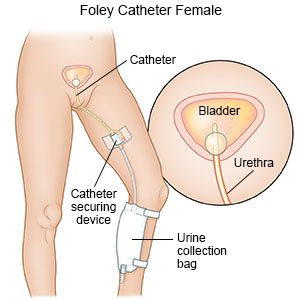
In the above picture, you can see what a foley catheter looks like. It's the yellow thing, that looks like there is a round ball near the end. The ball at the end is called a balloon, because well it's a balloon. It inflates and deflates. They use saline to inflate the balloon, and pull the saline out when they want to deflate the balloon.

After your urethra area is cleaned, the yellow tube is put into your urethra, and then into your bladder. Once it's in your bladder, the nurse will infuse some normal saline into the balloon at the end of the catheter, blowing up the balloon to what you see above.

This inflated balloon, will keep the foley catheter inside the bladder. Because the balloon is too big to fit in the urethra, it will sit on the bottom of your bladder. Sometimes this will create a sensation that you need to urinate, but you really don't. It's something that is a bit annoying and you just have to get used to it. 

As you see, after the balloon, there is still a little more of the catheter at the end of the tube. This is also in your bladder. It has a hole in it, in which the urine will drain out of your bladder. The catheter kind of becomes like a new urethra. 

When you have a catheter, your bladder doesn't have to flex to urinate, and your urethra, even if it's inflamed, is not strong enough to clamp the catheter closed. So in a way, it will give everything a break so it can heal.  

Oh my goodness did lots of urine come out the second that the foley entered my bladder! Within just a short 4-5 minutes the pressure in my abdomen decreased, and within 15 minutes the shortness of breath and chest pain left. What a relief!

The bag you see above is called a drainage bag. This will catch the urine, kind of like acting like a bladder. It allows you to be able to empty the urine from the bag periodically. 

The ER also had a catheter securing device, that was super sticky, and stayed put through showers and all! Look at the picture below for an example of a securing device. 

This was there to make sure if there was an accidental tug, the tug wouldn't happen to the balloon in my bladder (can you say OUCH!). Instead the tug would happen at the catheter securing device. 

The pictures below show a smaller urine bag and how the catheter securing device is put on. These bags are very portable. 

However if you are sleeping, you will want to use the larger drainage bag above. If your urine bag becomes too full of urine (like the smaller bag below could do at night when you produce a lot of urine), then you are setting yourself up to have the same problems as before. 

The urine will back up into your kidneys and you will have all the same symptoms as acute urinary retention, except for the bladder pain.

Because I just had BCG, I knew that I was just going to be in bed resting for days. So I only used the large drainage bag above.


How Long Do You Have to Have the Foley Catheter?

I'll give you the short answer... at least a day, maybe two or more. I had mine in for two days.

Greg and his ER doc colleague both agreed that the foley catheter should stay in at the very least overnight. We didn't want me to have to come back into the ER because I couldn't pee again. 

Ultrasound and Urinary Flushing

They did an ultrasound over my bladder. They put some cold gel on my lower abdomen, and used a wand thing (very technical name I know!) to view inside my bladder. It's not a big deal at all. It takes just a couple of minutes.  

If you've ever had an ultrasound when you are pregnant, it's exactly like that.

They wanted to see if there was a really large clot in there, preventing urine from coming out. For me, they didn't see a large clot. My urine coming out had a few small ones, but no big ones. So it was looking like the clot was not the culprit of preventing me from peeing.   

Urinary Flushing
Urinary Flushing

If there had been a really large clot, then they would have had to do what is called a urinary flushing. They would flush a bunch of saline through the catheter that is already inside you, causing turbulence inside your bladder, that would bust up the clot into smaller parts that could come out the foley catheter. 

When I talked to the urologist earlier that day, they said this was possibly something they would do in the ER.  

What is it Like to Have a Foley Catheter?

Nobody likes a foley catheter, but I was surprised how easy it was to have in. I was stressed about going to sleep with this thing, but again was surprised how easy it all was to maintain. 

Here are some tips that I found were useful the two days I had it: 

  • This is SUPER important! Whenever you are in a position for more than 10 minutes, you really need to make sure your bag is lower than your bladder. This means if you are standing, you will need to put it on the ground. Holding it with your hand at your side, is still too high. If you sit down to watch TV, put the bag on the ground. If you don't do this, the urine can back up, and start to stress your kidneys and body.
  • Wear a skirt or shorts with pockets. You don't want to walk on the tube, and if you were to wear pants that would be a possibility. Pockets will give you a place to hook the bag onto. It makes it easier to walk around with. 
  • Be super careful when walking around. You do NOT want the tube to hook onto something and get yanked. I hold onto the bag and the tube, to remind myself of this. Most likely if that happened, the sticker catheter securing device would take the brunt of a sudden pull, but there have been instances in which the foley catheter (with the balloon fully engaged!) gets pulled out. This can do some incredible damage to your urethra. You don't want that!
  • At night, hang the bag onto your bed frame. If that doesn't work, you might need to jerry rig something that can hold it. Being on the ground, makes it too short and you might not be able to turn in bed.

The reason you can’t wear long pants with this type of bag is that though the tube is long, it still is not long enough to thread all the way down your leg and back up to wear you can carry it around. You don’t/can't wear a bag this large inside your pants. It’s meant to be carried around and/or hooked onto a bedside.

The catheter securing device would occasionally pull to let me know that things needed to be adjusted. There was a second securing device that I clipped onto my underwear that was a second fail-safe. I put the bag trough my underwear hole where my leg goes, and then put my leg inside. 

It sounds more complicated than it is. Truly it's very simple.

In the first 14 hours of having the catheter in, I dumped about 5 liters of urine (1 gallon and 1 liter! 😲). I just woke up in the middle of the night, rolled over to check on it, and boy was I surprised! The 2.5 liter bag was nearly full!! 

I just walked to the bathroom (secure your bag and tubing), and for the first time in my life, I got a glimpse to see what it might be like to be a man. I opened the little clamp on the tube, and the pee when into the toilet. So simple and quick!

In some ways, it was nice having a catheter. Usually at this stage of getting BCG, it's so irritating that it hurts to pee for days. I didn't have any of that. 

There was some irritation/pain from having it in. It's not a total cake walk, but really I didn't think it was that bad either. 

By day 2 my bladder and urethra were not happy about this thing being in. I was grateful that I was able to get it out after 2 days.

The next day I chatted with my urologists nurse. They wanted for me to wait another day (so a total of 2 days having the catheter) to come into the office and get the catheter out. 


 Trial Without Catheter (TWOC)

Day #2 came, and off we went to the doctors office. I was feeling terrible like usual, 2 days after BCG. It was not awesome, all I wanted to do was lay in my bed and rest. But we all need to do what we need to do. 

At the urologist office, they wanted to do what is called a trial without catheter. After pulling the foley catheter, they wanted to make sure that I could urinate before going home. 

If I couldn't then this would mean another foley catheter would be placed and I would need to wait a longer period of time, with a foley catheter in.

It was all quite simple. Before taking out the catheter, the nurse or nurse assistant, will inject saline through the catheter and fill up your bladder with it (about 100-200 ml of saline). They put the saline in, until you start to feel pressure in your bladder. You let them know when this is, and then they stop injecting saline through the catheter.

Then they pull the catheter out. It's very simple and very quick. 

Off I go to the bathroom and... SUCCESS!!! I CAN PEE!!!!!!

 Unfortunately, it's not as blissful as the picture shows above. There is quite a lot of irritation in the urethra, and expect that for the next week. When you pee there will be some burning in your urethra, which is totally normal after having a foley catheter in. 

There was some slight urgency for the next 5 minutes or so, but that is normal when things get irritated in your urinary system.

The urologist chatted with us for a bit. I was really feeling sick by this time, so my hubby really did most of the chatting. He said the next time we do the BCG, he might want us to use a different medication than the oxybutynin, in case that was contributing to the bladder retention. 

They did run a urine culture, and it came back positive for a UTI (urinary tract infection). So I'll be on antibiotics for a bit.

Next BCG... in 6 months! It will be strange, and quite a relief to not have to think about BCG for so long. Just two cystoscopy's coming up in the next 6 months. It will be nice to have a break over the holidays. 

Unexpected Side Effect

An unexpected side effect of this happening to me, is that my BCG symptoms didn't go away until day NINE! Usually they are fully gone by day 7. 

The only thing that makes logical sense to me here is what happened on day 1, with not being able to pee. 

Usually, when you get BCG, you pee it out, and then over a period of 6 hours you will pee 4-20 times depending on what week you are on. During that time period, the BCG is being flushed out. It gets weaker and weaker in concentration as the hours tick by. 

After that initial BCG pee, I only had tiny pees for 1 hour. I was not able to flush much of the BCG out. 

So after only one hour, the BCG concentration was still pretty high. This concentrated (but still watered down due to the urine) BCG stayed in my bladder for the next 5 hours. 

So it was like I got an extra long BCG dose, thus I had more severe and extra long lasting symptoms. It has been a rough week. I'm so glad Greg had taken off a couple of extra days than we usually do for the last BCG week.


Chemo Wash After a TURBT

    Preventing Bladder Cancer Recurrence with Chemo Wash Before you get a TURBT, be sure to ask your surgeon if they are planning on doing a...